O-200 A... First Time Carb Icer?
Real Quick -> If you have a lot of experience with the Continental O-200, and you find something in this that isn’t right please reach out to me! I still have a lot to learn about this powerplant, and would welcome any and all advice! Email - klaptrap6@gmail.com
Backstory
A few years ago, the United States Army taught me how to fly helicopters. This was my first introduction to Aviation. Fast forward a few years and I decided to start learning how to fly airplanes. In the last 8 months I’ve gotten my Private Pilot certificate, as well as my instrument rating. My grand total of 105 fixed wing flight hours have consisted of 94 hours in a Cessna 172, and 11 hours in a Piper Arrow.
During my fixed wing training I was taught about carburetor icing. This training consisted of utilizing the carb heat during a low power setting. Generally in the 172 if we were below 1800 RPM we would turn the carb heat on. I never encountered carb ice, and didn’t give it much more thought.
Now fast forward to a month and a half ago, I was renting the local flight schools Cessna 172 often. My goal was to fly 10 hours a week - the end goal being my R-ATP. I started realizing that I was spending way too much money on renting and started looking into aircraft ownership. After running the numbers it became clear to me that owning an airplane would likely be considerably cheaper than renting if my end goal was to fly 10 hours a week until I finally hit my 250 fixed wing PIC requirement.
One of my buddies that I fly with in the Army is a CFI / CFII / A&P who happens to own a Cessna 150, we’ll call him Jack. When a fairly priced Cessna 150L came up for sale in Michigan I knew Jack was the guy to help me. He was incredibly helpful, drove to Michigan with me (from Wisconsin) and did a pre buy. Everything lined up nicely, and in early January I became an aircraft owner.
About the Plane
If you’re hear reading this you’re probably an aviation geek (hey I’m getting there). So heres a little about my plane.
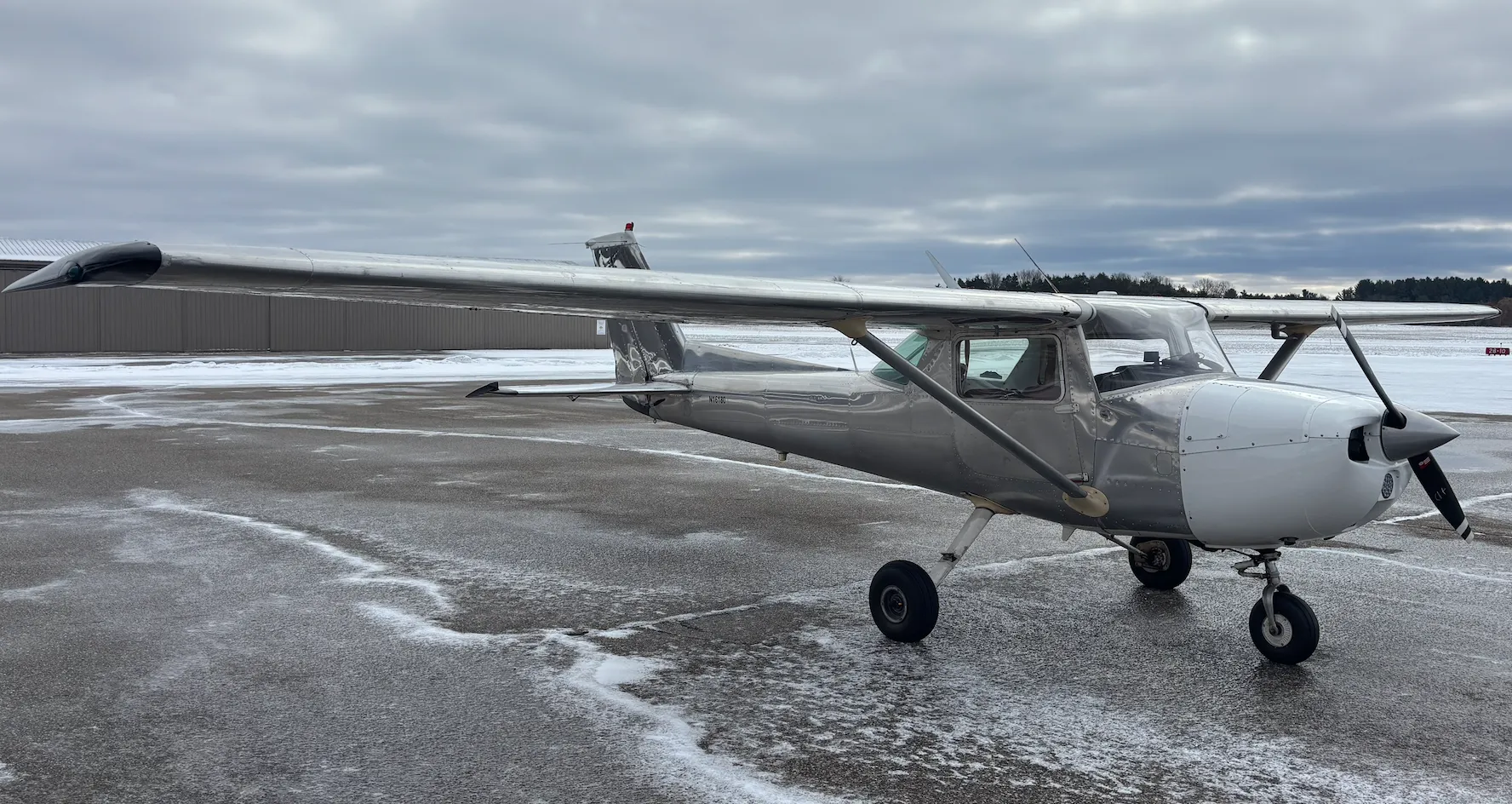
Full of gas, and ready for the trip back to WI!
Its a 1972 Cessna 150L Commuter. Its got the normal sized fuel tanks (26 total gallons). Its got a Garmin 355 in it which makes it LPV capable. The engine on it is 720 SMOH, and its got a climb prop on it.
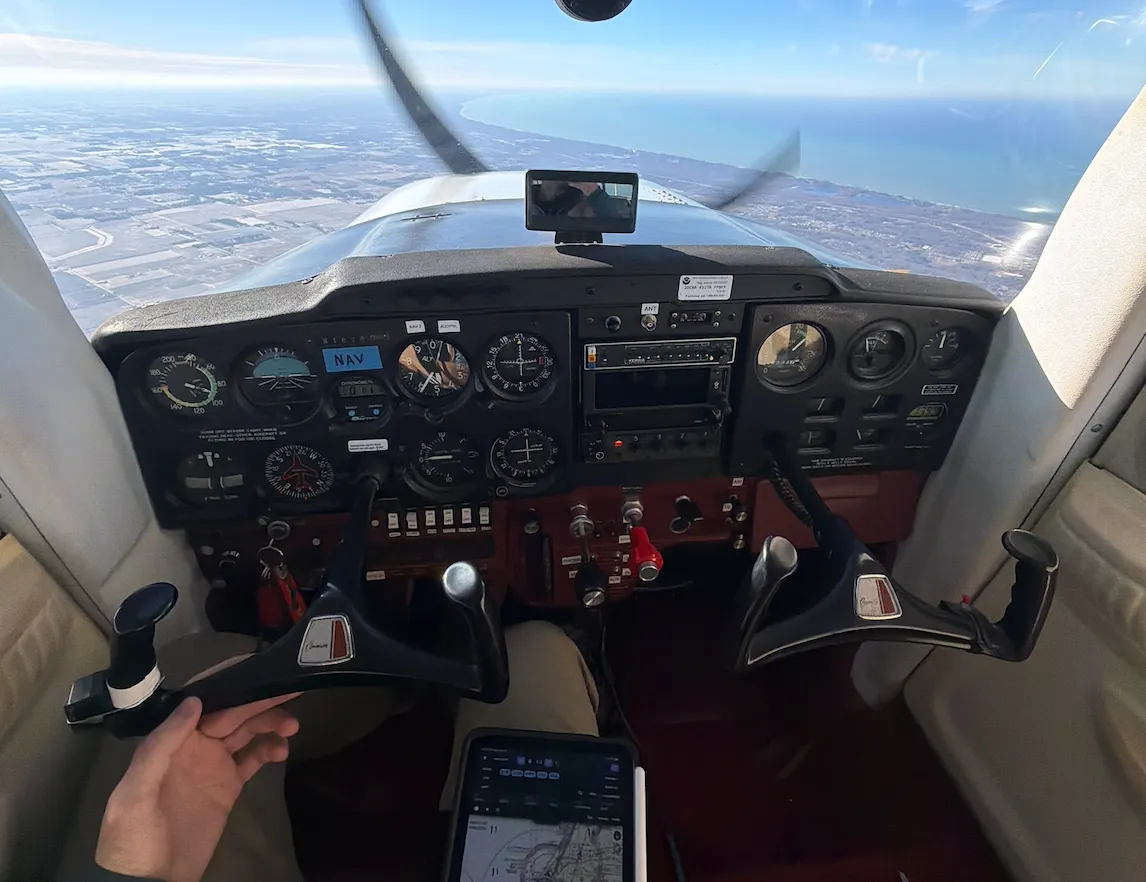
Lake Michigan on the horizon, smooth skies, and a decent tail wind!
With that being said, it should hopefully fit my mission pretty well for building cheap flight hours. I’ve still only got 5hrs in it, but over the course of the next year (next annual is due in NOV) I’m hoping to get at least 5hrs a week in it - which will get me my 250 fixed wing PIC prior to the annual. Now whether or not this was a sounds investment - thats to be determined. I’ll have to get back to you on that.
The Very First Flight
Now because I didn’t have a single C150 hour, the insurance company said that I needed a sign off from a CFI. As it turns out, finding last minute C150/CFI time is not super easy. A last minute flight window opened up between WI and MI on a Monday. I found this window on a Saturday afternoon - naturally there was nobody in Wisconsin who could get me that sign off on Sunday. Luckily enough, there was a CFI at the pick up location who had availability on Monday morning. He met me at the airport early Monday morning, and I got to fly my airplane for the first time.
The first thing that I noticed was how smooth all of the controls are. I must just be accustomed to the flight school 172 I fly, but compared to that, this 150 was as smooth as butter. Being able to turn without needing the brakes??? Unheard of in the flight school trainer. I was also impressed that at max gross weight (1600lbs) I was able to get a climb rate of 700 fpm - granted the DA that day was hovering around -2,000, but still… I was expecting 200 fpm fully loaded.
We took off out of Fremont (KFFX), and did all of the basic manuevers. After we finished our maneuvers, the CFI told me that we had carb ice. This wasn’t necesarrily alarming, but it did get my attention. He explained to me that the Continental O-200 is known for carb ice. He calmly explained that when we turn the carb heat on we will see a drop in RPM, and then we will see a rise in RPM - this was new to me. He had me turn the carb heat on, and I observed the RPM drop that I was used to seeing, and then sure enough, it came back up a little bit. We left the carb heat on for 30 or so seconds, turned it off, and the RPM returned to normal cruise. As someone who had never seen carb ice it seemed like a good learning moment. We continued our flight, ripped the pattern for a few laps and then called it a day. I was now signed off in my new (to me) Cessna 150.
After getting on the ground I asked the CFI a little bit more about carb ice in the O-200, was this possible at cruise, or just during lower power settings? He explained that when he flies his 150 he will pay close attention to his power setting, and if he suspects carb ice he will just pull the carb heat on every 15 minutes or so. If it doesn’t stumble when turning the carb heat on or if he doesn’t get a drop and then rise he doesn’t have carb ice so he turns the carb heat back off. — “Makes sense to me” I thought.
Ferry Flight Home - Phase 1
Based on the little POH that came with the plane, I suspected a fuel burn of about 4.6 gallons/hr. It looked like the highest possible burn was 6 gallons per hour. I was incredibly conservative and planned on using 6 gallons to run up and reach top of climb, and a 1hr fuel reserve (even though it was day VFR and my legal requirement was 30 minutes at cruise). Given the 22.5 usable gallons of fuel aboard, this meant I’d get about 10.5 gallons to play with. Given the weather and winds that day, this meant my best bet on a fuel stop was Lansing Munincipal - KIGQ. Departing KFFX the ceilings were around 2,000’, this lasted for about 20 minutes and eventually I was able to get up to 6,500’. As a religious follow of Opposing Bases, I got up with approach for VFR Flight Following. Trying to keep as many penguins on my iceberg as possible, I talked with approach and flight followed up until my freq change at KIGQ. I landed, taxied to the pump, and filled it up on gas. 11.3 gallons taken ( a little off on my planning). I stopped into the FBO to check my route for phase 2, pack my bag, and take a leak. I was super excited about how the airplane was flying.
Ferry Flight Home - Phase 2
At KIGQ I started the plane, and taxied to the runway. On the way there, there was a 172 who was back taxiing. I wasn’t sure if they were headed for the ramp or for another take off. I called them on CTAF to ask, naturally they didn’t reply (I miss radio calls too, not a jab), so I pulled off to an open area and did my run up. Eventually they called for takeoff, so I taxied up, made a call, and took off. I made a right hand turn out to the West, and began a climb. After letting KIGQ traffic know what I was doing I changed over to Chicago Approach, and gave them a call. Now I heard on an OB (Opposing Bases) podcast that when you call for VFR flight following, the controller has to create a slip/tag for you, and supposedly the order of information that they input is Callsign -> Location -> Destination -> Type -> Altitude. So I gave them the info in that order, they asked a few questions, I got my squawk code and was on my way. The controller asked me if I wanted to transition the VFR corridor East of Chicago, or stay clear of the Bravo to the West. I was hoping to get cleared through the Bravo - but let them know I’d stay clear to the West. I had absolutely not studied the VFR corridor well enough to utilize it, so West of the Bravo it was.
I climbed up to 6,500’ and was on my way.
I had set the power to 2,400RPM - this was giving me 85 MPH indicated. I was trying to keep it at exactly 2,400 for as long as possible so that I could try to figure out what my fuel burn at cruise was. Maybe 45 minutes into the flight I was due West of Chicago, still talking to CHI Appr, and was almost directly over KARR -> Aurora Municipal. I noticed that the current power setting was sitting at 2,300RPM. “Alright, this must be some carb ice” I thought to myself. I turned the carb heat on, saw the RPM drop, and didn’t observe any other needle fluctuation. “Hmmm, maybe not carb ice then - the throttle knob must have just worked itself loose over the last 45m”. I pushed the Carb Heat handle back in, and the engine went from 2,200 RPM down to 1,200RPM. THIS got my attention - I instinctively pulled the carb heat back on, and the engine recovered.
At this point, I had some adrenaline pumping through my system. This was new. I’ve never seen the engine drop below 2,000 unless I was adjusting the throttle knob. “Okay” I thought to myself, Fly the Aircraft - this is what the Army teaches us for emergency procedures. Fly the aircraft above all else.
My Engine RPM was normal, oil pressure / temperature was normal, airspeed was 85, altitude 6,500, and my attitude was wings level with no climb or descent. The only oddity with any of the controls at this point was that I had the carb heat turned on.
My next thought was to check my mixture. When I was climbing through 3,000 I had leaned the mixture so I was running rich of peak. When I got to my cruising altitude I did that again just to make sure. So I slowly spun the mixture handle out, after a few turns the engine began to stumble, I turned it back in a few times and it went back to running normally. I then tried adjusting the throttle a bit, pushing the throttle in the engine ran fine, pulling more power out, the engine would begin to tumble. “Okay, so more throttle seems to be better for the engine - full throttle it is.”.
At this point I wasn’t sure what to do, so I got out the POH and read the section for Engine Roughness.
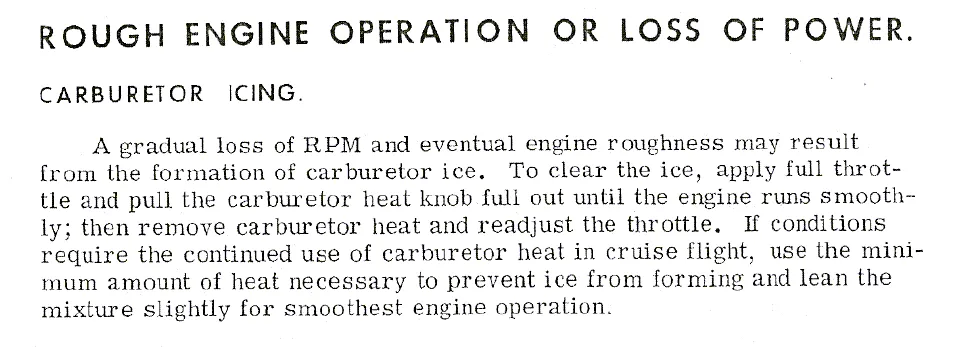
I followed the below steps thinking to myself “I don’t think I have carb ice - the engine RPM didn’t come back, and it also didn’t run roughly with carb heat applied, but I don’t know what else it would be”. So I decided that this must be some kind of carb ice, and in the checklist it says to use the minimal amount of carb necessary. “Okay, thats a good plan” so I began to very slowly push the carb heat off. At about the halfway point, the engine tumbled down below 1,000RPM. I don’t know how low it got, I was busying trying not to sh*t myself, while simultaneously pulling the carb heat lever back at a rate that probably should have pulled it out of the dash…
With the carb heat pulled back on all of the way, the engine came back to normal. I knew it was time to get on the ground though. I looked at my map, and decided that given my power setting and alitude I would likely make it to Dekalb KDKB. I called approach to let them know I was having engine issues and needed to divert to Dekalb. They asked me if I was declaring an emergency, to which I said “Not Yet”. They cleared me to DeKalb and let me know that if I needed any help they were there (+1 for VFR flight following). I considered the fact that I was likely just short of glide distance to DeKalb, but the thought of doing a power off spiral to the class D below me seemed like a bad time to practice that for the first time. Given that the engine was running okay at full power I thought I’d likely make DeKalb.
Now the next question I had to ask myself - How do I descend 6,000 feet with full power applied? I put the nose down, added right aileron, and left rudder. This was a new manuever too. I’ve practiced slips before, but not for an extended period of time.
As I was coming through about 3,000 feet approach asked me if I wanted to stay with him to the ground. I told him I’d like to switch to CTAF to try and clear the area out. He approved it, I squawked VFR, and loaded in the KDKB CTAF freq. There were a few people in the pattern - they were all very helpful and got out of my way I way as I came in to land to the West. Once I knew I had the runway made I felt quite a bit better, and was comfortable pulling the power back and working in the flaps. Surprisingly to me, the engine didn’t have any issues at a lower power setting now.
Over the numbers I brought the engine to idle, landed without incident, and taxied off the runway. Once I was on the ramp I turned the carb heat off, and the engine just kept on running like nothing was wrong. I taxied to the FBO, shut it down, and took a breath. I noticed that both of my hands were shaking.
What Went Wrong?
I eventually had two A&P mechanics look at the plane. The local A&P couldn’t find anything glaringly wrong with the plane. The mixture assembly on the back of the Carb was contacting the mixture set screw. He adjusted the screw in a little bit and the mixture was not able to operate smoothly through the full range of motion. (Prior to this there was a small section when leaning where I couldn’t just turn the knob, and had to instead pull it out past the stop).
Besides that though, there was nothing that stuck out to him. I did a run up in the plane, and everything was as expected. Since it was getting dark at this point I decided I wasn’t going to fly home in the dark.
My next task (after getting home) was figuring out how to also get the plane home. Lucky for me, Jack has a wife who also flies. She ended up flying him down to get the plane earlier this week. Having Jack fly the plane home seemed like the right move to me. If anything was going to go wrong his A&P brain, and CFI experience would hopefully allow him to diagnose the problem in flight (hes also got around 1900 more hours in an airplane than I do :D ).
Upon arrival he found that the mixture was still contacting something on the carb. As it runs out the cable was on the wrong side of the “pivot plate” (thats the wrong name - if I find the right one I will update this). He fixed this, and flew the plane home. He had no issues.
With the lack of a smoking gun, his belief was that I ran into carb ice. Because we couldn’t find anything else wrong with the plane, there really isn’t a great explanation. My only “gripe” with the carb ice explanation is that I didn’t see any sort engine RPM change after applying the carb ice. YES - the RPM did drop, but the engine didn’t tumble, and the RPM didn’t come back up. Having never seen carb icing except that morning I don’t have the right answer.
Lessons Learned
Since this incident, I’ve done A LOT of research on carb ice. As it turns out, there is a group of people on the internet that refer to the Continental O-200 as the Ice Machine.

Between reading different articles, forums, and even reaching out to various Cessna 150 owners, I’ve learned that the O-200 does indeed like to make ice.
-
If you have carb ice, and its pretty light - applying carb heat will cause an RPM drop, the ice will melt, and then the RPM will come back up a little.
-
If you have a lot of carb ice - applying carb heat will cause an RPM drop, the ice will melt, and melt, and melt, causing the engine to run not great. In some scenarios the melting of the ice has been enough to kill the engine. You have to try and wait it out, and eventually when the ice is gone the RPM should come back.
-
If you have carb ice, more throttle is better than less throttle. When you have less throttle, the butterfly valve closes, which can create more ice quicker. The further open that valve is, the harder it is for ice to form. This leads me to believe that a lot of throttle and all of the carb heat might be the best combo when you’ve got ice.
-
If you have a lot of carb ice, pulling the carb heat full on might kill your engine. Some people use a technique where they will slowly work the carb heat on. The thought being that you’ll slowly melt the ice, and keep the engine lit.
-
Know what max RPM looks like in your plane. On takeoff, if you don’t have max RPM you might have carb ice. If you don’t see max RPM, just abort the takeoff.
-
Carb ice is absolutely possible at cruise.
-
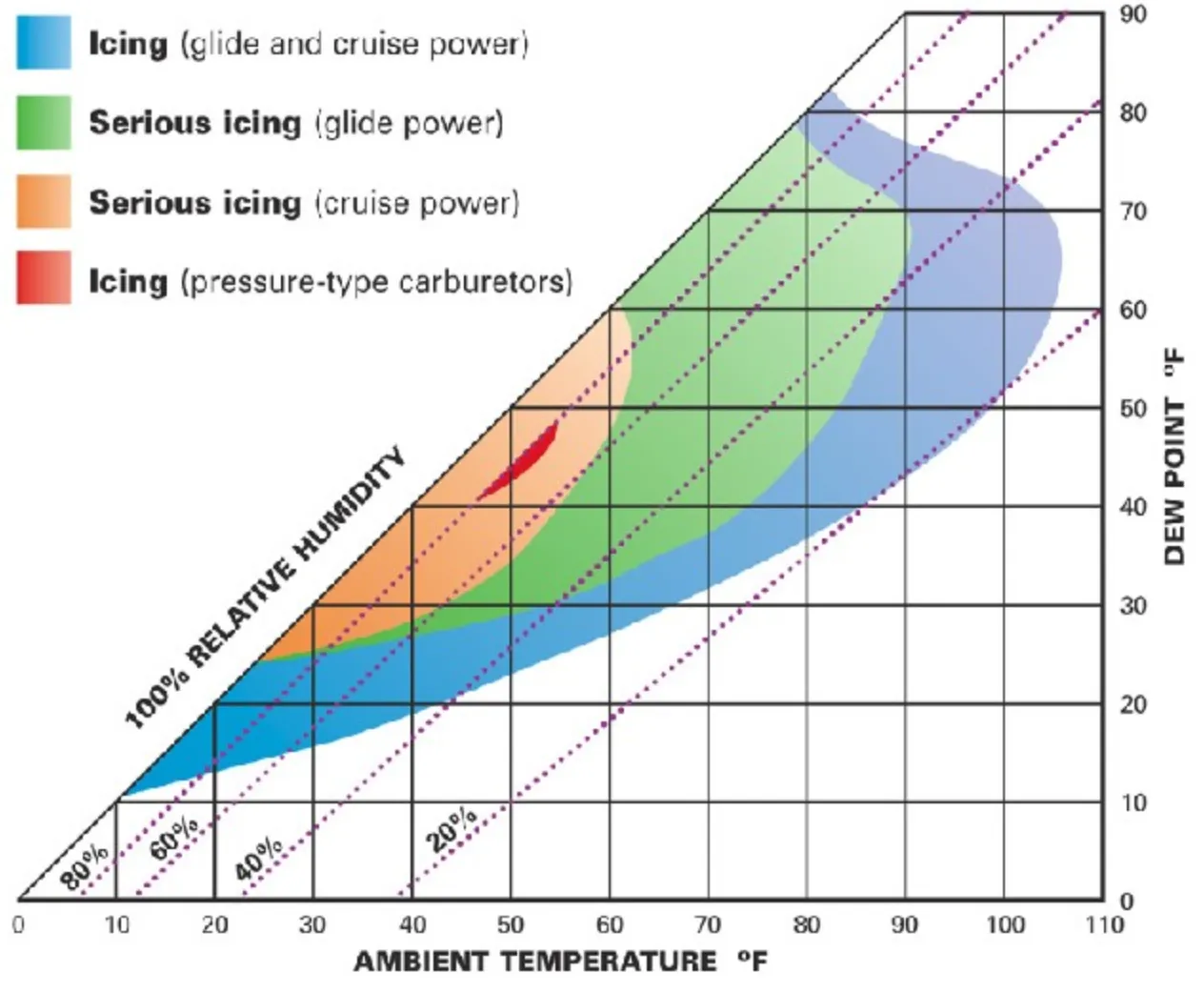
Theres a carb ice chart, you can predict this stuff based on your flying conditions! ( I was in the blue, almost orange range on this day.)
-
When you encounter carb icing, it can take up to 20 minutes to get rid of the ice. Turning the carb heat on for 30 seconds isn’t going to do much for you unless you have a very minimal amount. If you apply carb heat and the engine RPM fluctuates, just keep the carb heat on until it levels off.
-
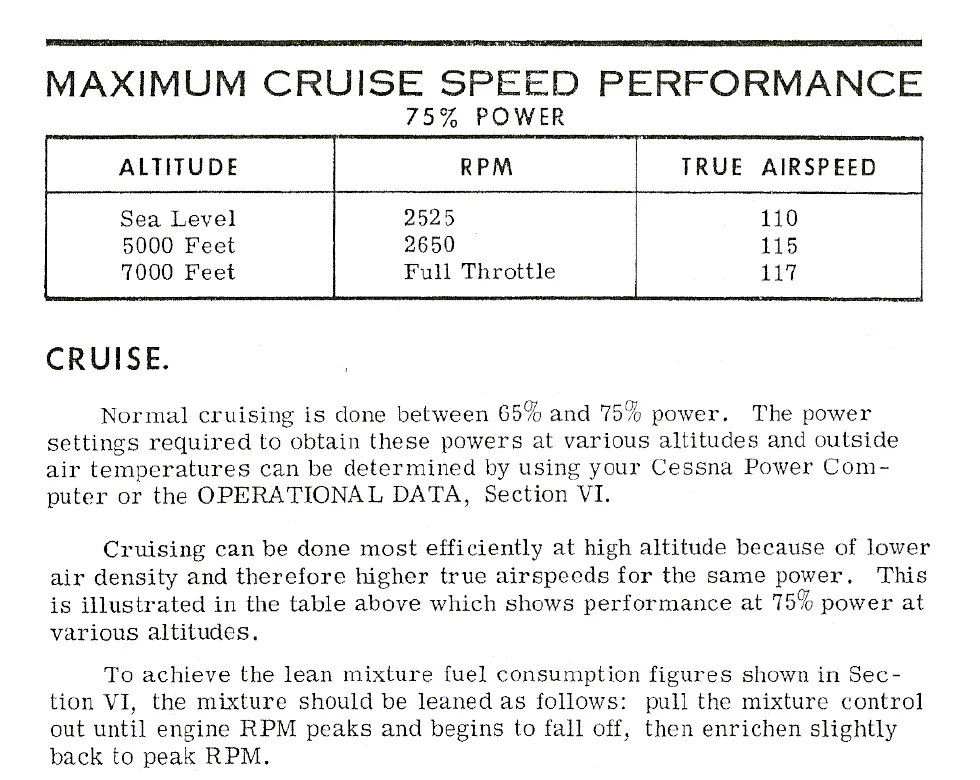
Running the engine at a higher power setting can help prevent carb ice on days when its more likely. Cessna actually has a recommended RPM for good power at cruise (which is higher than I was running). Based on the below table from the POH, I was running with anywhere from 200 - 300 RPM less than I could have been. Now is running at max power for hours on end good for the engine? I don’t know - but based on that table if you’re high enough cessna seems to think its okay.
What I Should Have Done Better
While I don’t have thousands of flight hours, I do know that in aviation the stakes are pretty high. As soon as you’re off the ground, the only given is that you will eventually come back to the ground - our job as a pilot is to ensure that coming back to the ground is on our own terms. WHEN you encounter a scenario that could have been potentially been catastrophic, and it is not it catastrophic, it is imperative that you accept that event as an incredible learning opportunity. Analyze what happened, what you did, what the outcome was, and what you wish you would have done. Then the next time this event comes up maybe you are able to avoid it entirely, or produce a better outcome than the first time you experienced it. With that being said, here are what I think my biggest mistakes are, and what I’m going to do next time.
Improves
- When my engine almost quit - I was directly over a Class D airport. My engine didn’t end up quitting, however there was probably a 2 minute period when I was on my way to Dekalb where if the engine had quit, I would have ended up in a field.
- As soon as it warms up here one of my first tasks is to find an airport, and practice spiraling down from 5 or 6 thousand feet with the power at idle (make sure its not a carb ice kind of day!).
- This needs to be practiced until circling over an airport to land without power is a NON EVENT.
- Upon reflecting on the flight, I did notice a slight vibration to the aircraft that wasn’t there on the first leg. Maybe 15 minutes after noticing this is when I ran into engine issues. Rather than ignoring this I should have began to trouble shoot.
- Include the carb ice chart in the flight planning process. At least have an idea of how likely it is for the day.
- Make checking for carb ice a regular event, maybe every 20 minute? Similar to doing fuel checks in the helicopter.
Sustains
- VFR Flight follow - this is a no brainer. ATC is there to help, plus talking to them is good practice.
- If you flip a switch or pull a knob, and the expected result does not occur, replace that switch or knob, and re-evaluate.
- Remain calm in the air.
Relax. Look Around. Make a Call- Fly it to the ground
Conclusion
If you’ve made it this far, thank you random internet stranger for reading about my close call! If you have further recommendations our thoughts on this please reach out to me via email: klaptrap6@gmail.com - I’d like to hear your ideas and opinions on this scenario.